The reason of this blog
Published:
Every journey has a beginning and an end. These wise words encapsulate the essence of this fresh and young blog. As a next step, I would like to describe the main ideas behind this research blog. My first objective is to connect interesting resources, ideas, questions, and ongoing projects related to the orchestrated regulatory pathways triggered by non-coding RNAs. The collection of ideas and papers will be supported by relevant literature and insights that I have developed through my research journey. Initially, my main focus will be on the study of the regulation triggered by microRNAs (miRNAs), and in the near future, I plan to expand my scope to other small ncRNA families.
The concept of genomic regulation: a brief review
Regulatory patterns governed by small non-coding RNAs have been previously reported with deep and illustrative examples derived from the study of RNA interference mechanisms (RNAi). The study of small-interfering RNAs and microRNAs has changed the regulatory paradigm, where previously, regulatory steps were thought to be generated by protein counterparts. Seminal papers published in the early 2000s, including the independent work of the Ambros and Y groups, led to a detailed understanding of the action of miRNAs in regulatory mechanisms as a consequence of the targeting interaction between a small mature region from the miRNA and the targeted mRNA using Watson and Crick interactions. The impact of these publications, coupled with the Nobel Prize in Medicine awarded to Melo’s group for the discovery of the RNAi mechanism, brought attention to the regulatory research field. The discovery of conserved and spread dispersed regulatory patterns across multiple animals and plants has highlighted the importance of this topic for further research.
Interestingly, these events can be correlated with the frequency of words that appeared in books mapped during this period of time (Figure 1).
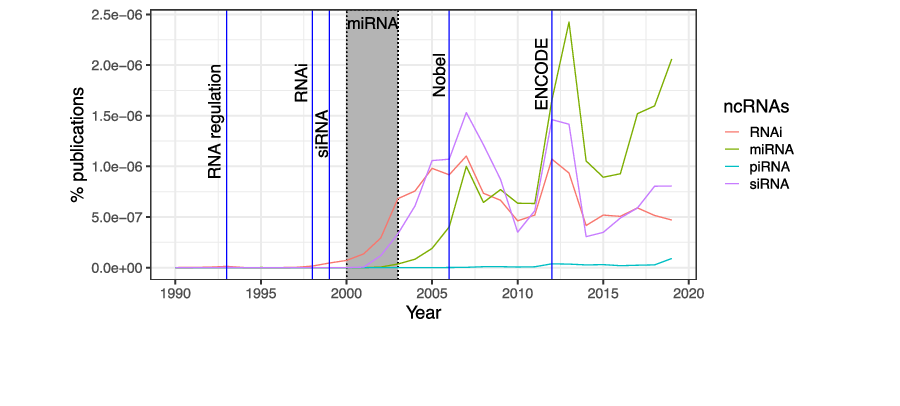 Figure 1: Ngram plot for ncRNAs related with regulatory pathways
Despite the regulatory mechanism being proposed in 1994, it was not until 10 years later that the phenomenon was characterized and cataloged. The main peaks in research occurred after the Nobel Prize and the publication of the ENCODE human genome annotation. MiRNAs are the most widely published topic in comparison to other small ncRNAs involved in regulation. In this context, these small molecules represent a rich resource of regulatory pathways that are waiting for proper characterization.
Conclusions
- Regulatory landscape interacts with protein and non-protein coding RNAs, history reported key developmental, conserved and spread mechanisms over plants and animals.
- Over the characterized small non-coding RNAs involved on the regulatory process, microRNAs are the most studied and reported on the literature term.
- Triggered interest was due a significant relevance at science in general, the Medicine Nobel Prize given by the discovery of the RNAi and the first report of the ENCODE project that reported a huge transcription of non-coding RNAs.