Industry collaboration
From RNA data to decisions
Computational RNA biology can turn complex sequence, structure, and evolutionary evidence into analyses that research and development teams can inspect, test, and reuse. I bring an evidence-led approach to problems where dependable annotation, comparative context, or a tailored computational method can reduce uncertainty and clarify the next experiment.
Evidence at a glance
- Ph.D.-level computational biology: Ph.D. in Computer Science focused on large-scale workflows for studying miRNA evolution. View the CV.
- Cross-institutional research: RNA and genomics collaborations spanning universities and research groups in Austria, Germany, Colombia, Brazil, the Netherlands, and the United Kingdom. View experience and collaborators.
- Published RNA and genomics work: peer-reviewed research covers microRNA detection and evolution, ncRNA annotation, tRNA evolution, genome analysis, and RNA structure. Browse publications.
- Reproducible pipeline development: experience building Snakemake, Galaxy, cluster-based, and version-controlled workflows, including the public miRNAture annotation pipeline. View technical experience.
Capabilities
RNA annotation and validation
Evaluate candidate non-coding RNAs using sequence, structure, homology, and evolutionary evidence, with clear criteria for reviewing results.
Comparative genomics
Design cross-species analyses that distinguish conserved signals from lineage-specific change and help prioritize biologically meaningful candidates.
Reproducible bioinformatics workflows
Build auditable pipelines with explicit inputs, versioned methods, quality checks, and outputs that teams can interpret and rerun.
Custom predictive modeling
Translate a biological question into an appropriate statistical or machine-learning prototype, including feature design, evaluation, and limitations.
How an engagement works
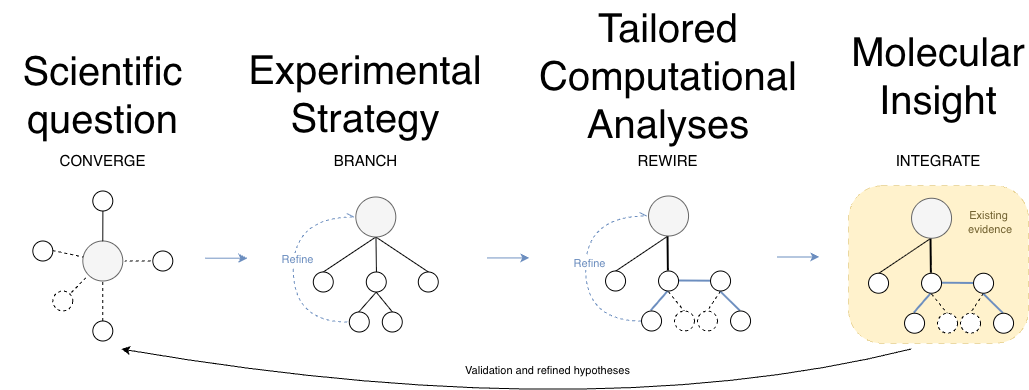
I currently welcome initial conversations about academic research and industry collaboration. The preferred first step is a short email outlining the scientific question, the data available, and the decision or outcome the work should support.
Good fit
Representative projects include:
- Reviewing or improving an existing ncRNA annotation set.
- Comparing RNA families, structures, or regulatory features across species.
- Auditing and refactoring a bioinformatics analysis for reproducibility.
- Developing an interpretable proof of concept for an internal research question.