<?xml version="1.0" encoding="utf-8"?><feed xmlns="http://www.w3.org/2005/Atom" ><generator uri="https://jekyllrb.com/" version="3.10.0">Jekyll</generator><link href="https://cavelandiah.github.io/feed.xml" rel="self" type="application/atom+xml" /><link href="https://cavelandiah.github.io/" rel="alternate" type="text/html" /><updated>2026-09-28T09:18:32+02:00</updated><id>https://cavelandiah.github.io/feed.xml</id><title type="html">Cristian A. Velandia Huerto | Computational RNA Biology</title><subtitle>Computational RNA biology, comparative genomics, and reproducible bioinformatics.</subtitle><author><name>Cristian A. Velandia Huerto</name><email>cavelandiah@tbi.univie.ac.at</email></author><entry><title type="html">Including mature sequences on miRNA structural alignments</title><link href="https://cavelandiah.github.io/posts/2023/04/blog-post-2/" rel="alternate" type="text/html" title="Including mature sequences on miRNA structural alignments" /><published>2023-04-11T00:00:00+02:00</published><updated>2023-04-11T00:00:00+02:00</updated><id>https://cavelandiah.github.io/posts/2023/04/blog-post-2</id><content type="html" xml:base="https://cavelandiah.github.io/posts/2023/04/blog-post-2/"><![CDATA[<p>Current structural alignments from Rfam use a precursor sequence to build the alignments. The sequence and position of the miR and miR* mature sequences are not reported and not considered to build such alignments.  This approach propose the improvement of the structural aligments from such microRNAs by using anchored alignments, using the mature annotation available on the miRBase and <code class="language-plaintext highlighter-rouge">mlocarna</code> to re-calculate those alignments.</p>

<h1 id="methods">Methods</h1>

<h2 id="getting-the-data">Getting the data:</h2>
<p>I’ve created an automatic pipeline to get the updated information miRNA containing databases: Rfam and miRBase. Using <code class="language-plaintext highlighter-rouge">posgresql</code> I was able to retrieve the data from RFAM (v.14.9), where I retrieved all miRNA families and that incluided at least one metazoan sequence in their <em>full</em> alignment. I retrieved the sequences using <code class="language-plaintext highlighter-rouge">wget</code>. In the same way, from <code class="language-plaintext highlighter-rouge">miRBase</code> (v.22.1), I got the files <code class="language-plaintext highlighter-rouge">harpin.fa</code> and <code class="language-plaintext highlighter-rouge">mature.fa</code>:</p>

<div class="language-bash highlighter-rouge"><div class="highlight"><pre class="highlight"><code>wget https://mirbase.org/ftp/CURRENT/hairpin.fa.gz
wget https://mirbase.org/ftp/CURRENT/mature.fa.gz
</code></pre></div></div>

<p>To get the mapping relation between both databases, I blast the Rfam sequences
to the miRBase database. The mapping relation was defined as:</p>

<ul>
  <li>100% identity percent.</li>
  <li>Zero gaps/insertions.</li>
  <li>Word size = 40.</li>
</ul>

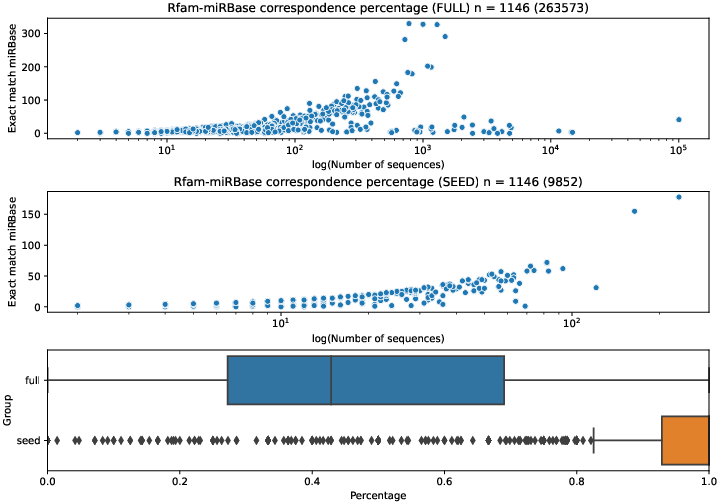
<p>Based on those initial results, the corresponding candidate must be annotated in
the same specie. I plotted this relation based on the counts from the blast
results for each sequence, accounting for the percentage of sequences that
reported a correspondence in the miRBase. This value was calculated for <em>seed</em>
and <em>full</em> alignments, as seen in Figure 1.</p>

<h2 id="results">Results</h2>
<p><img src="/images/correspondence_databases_match_species.png" alt="Correspondence between Rfam and miRBase sequences." title="Correspondence between Rfam and miRBase sequences." /></p>

<!---
General ideas about the mature position and prediction
======
By this way, the idea is to have the fasta sequences provided by RFAM. Correlating
the reported accession numbers with the relationship table, results in a split of the
provided RFAM sequences in 2 groups:
one_to_one : which represents those ones that have a representation along RFAM and miRBase.
one_to_many: Candidates represented only in RFAM alignments.
Inside the one_to_one group, exists a set of mature sequences already annotated on miRBase,
and should be used together with MIRfix to correct the reported mature(s) positions.
Once those ones are corrected and updated in terms of positions, is possible to annotate 
the other one_to_many set of sequences. Before that, I realised that RFAM seed aligments have
been made from a curated set of sequences (seed) which are reported in the database file:
seed_region_RFAM14.txt
Then, before include the one_to_many sequences, a previous filter step will be performed in
order to attach only those sequences that are previously classified as seed by RFAM.
Those means that the final multiple sequences file that will be submitted to MIRfix is composed
by:
- Mature position corrected one_to_one sequences as sequences with annotated matures from miRBase.
- One_to_many sequences, which are previously classified as seed. This set of sequences will be
the target sequences which MIRfix will annotate the correct position of the best mature sequence. 
The output files from this methodology are the multiple Stockholm alignment and the positions 
of the mature(s) sequences along all of the seed sequences from the Covariance Model. At the end,
sequences that are not included into the alignment will be discarted. 


miRNAture: correction of the RFAM sequences
-----
Based on the complete fasta sequences from RFAM v14.1, located on: 

`/scr/k70san/bogota_unal/miRNAsTunicata/miRNAture/Code/RFAM_Processing/Data/RFAM14-1Fasta`

is possible to execute the 3 stages of the pipeline: create, execute and final.
In this case, the first one is create the required files to run MIRFix.
then, to execute all please run:

`./execute_correction_RFAM_miRNA.sh`
-->]]></content><author><name>Cristian A. Velandia Huerto</name><email>cavelandiah@tbi.univie.ac.at</email></author><category term="microRNA" /><category term="mature annotation" /><category term="secondary structure" /><category term="alignments" /><summary type="html"><![CDATA[Current structural alignments from Rfam use a precursor sequence to build the alignments. The sequence and position of the miR and miR* mature sequences are not reported and not considered to build such alignments. This approach propose the improvement of the structural aligments from such microRNAs by using anchored alignments, using the mature annotation available on the miRBase and mlocarna to re-calculate those alignments.]]></summary></entry><entry><title type="html">The reason of this blog</title><link href="https://cavelandiah.github.io/posts/2023/04/blog-post-1/" rel="alternate" type="text/html" title="The reason of this blog" /><published>2023-04-09T00:00:00+02:00</published><updated>2023-04-09T00:00:00+02:00</updated><id>https://cavelandiah.github.io/posts/2023/04/blog-post-1</id><content type="html" xml:base="https://cavelandiah.github.io/posts/2023/04/blog-post-1/"><![CDATA[<p>Every journey has a beginning and an end. These wise words encapsulate the essence of this fresh and young blog. As a next step, I would like to describe the main ideas behind this research blog. My first objective is to connect interesting resources, ideas, questions, and ongoing projects related to the orchestrated regulatory pathways triggered by non-coding RNAs. The collection of ideas and papers will be supported by relevant literature and insights that I have developed through my research journey. Initially, my main focus will be on the study of the regulation triggered by microRNAs (miRNAs), and in the near future, I plan to expand my scope to other small ncRNA families.</p>

<h1 id="the-concept-of-genomic-regulation-a-brief-review">The concept of genomic regulation: a brief review</h1>

<p>Regulatory patterns governed by small non-coding RNAs have been previously reported with deep and illustrative examples derived from the study of RNA interference mechanisms (RNAi). The study of small-interfering RNAs and microRNAs has changed the regulatory paradigm, where previously, regulatory steps were thought to be generated by protein counterparts. Seminal papers published in the early 2000s, including the independent work of the Ambros and Y groups, led to a detailed understanding of the action of miRNAs in regulatory mechanisms as a consequence of the targeting interaction between a small mature region from the miRNA and the targeted mRNA using Watson and Crick interactions. The impact of these publications, coupled with the Nobel Prize in Medicine awarded to Melo’s group for the discovery of the RNAi mechanism, brought attention to the regulatory research field. The discovery of conserved and spread dispersed regulatory patterns across multiple animals and plants has highlighted the importance of this topic for further research.</p>

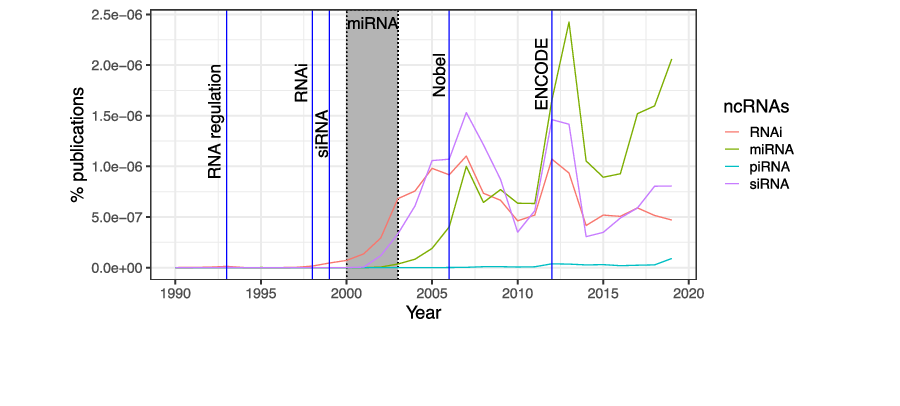
<p>Interestingly, these events can be correlated with the frequency of words that appeared in books mapped during this period of time (Figure 1).</p>

<p><img src="/images/regulationHist.png" alt="Regulation discoveries and map of books" title="Reseach on
regulation driven by small ncRNAs" />
<em>Figure 1: Ngram plot for ncRNAs related with regulatory pathways</em></p>

<p>Despite the regulatory mechanism being proposed in 1994, it was not until 10
years later that the phenomenon was characterized and cataloged. The main peaks
in research occurred after the Nobel Prize and the publication of the ENCODE
human genome annotation. MiRNAs are the most widely published topic in
comparison to other small ncRNAs involved in regulation. In this context, these
small molecules represent a rich resource of regulatory pathways that are
waiting for proper characterization.</p>

<h1 id="conclusions">Conclusions</h1>
<ul>
  <li>Regulatory landscape interacts with protein and non-protein coding RNAs,
history reported key developmental, conserved and spread mechanisms
over plants and animals.</li>
  <li>Over the characterized small non-coding RNAs involved on the regulatory
process, microRNAs are the most studied and reported on the literature term.</li>
  <li>Triggered interest was due a significant relevance at science in general, the
Medicine Nobel Prize given by the discovery of the RNAi and the first report
of the ENCODE project that reported a huge transcription of non-coding RNAs.</li>
</ul>]]></content><author><name>Cristian A. Velandia Huerto</name><email>cavelandiah@tbi.univie.ac.at</email></author><category term="regulation" /><category term="RNAi" /><category term="microRNA" /><category term="first post" /><summary type="html"><![CDATA[Every journey has a beginning and an end. These wise words encapsulate the essence of this fresh and young blog. As a next step, I would like to describe the main ideas behind this research blog. My first objective is to connect interesting resources, ideas, questions, and ongoing projects related to the orchestrated regulatory pathways triggered by non-coding RNAs. The collection of ideas and papers will be supported by relevant literature and insights that I have developed through my research journey. Initially, my main focus will be on the study of the regulation triggered by microRNAs (miRNAs), and in the near future, I plan to expand my scope to other small ncRNA families.]]></summary></entry></feed>